Last updated 2026-07-30
TL;DR
There's no herbal or 'natural' compound that does what methylene blue does biochemically (it's a synthetic redox cycler). The closest comparisons for mitochondrial support are CoQ10, PQQ, NAD+ precursors, and red light therapy, each with its own small human evidence base, none as strong as claimed. Methylene blue itself is FDA-approved only for methemoglobinemia; energy and cognition uses are off-label [1].
Is there a natural version of methylene blue?
No. This trips people up because methylene blue sounds like it could be a plant extract or a dye derived from something natural. It isn't. Methylene blue (methylthioninium chloride) is a synthetic phenothiazine dye first made in 1876 by the German chemist Heinrich Caro, originally for dyeing cotton, and later put into medicine by Paul Ehrlich [1]. There's no botanical precursor, no food source, nothing you can forage or grow that gives you the same molecule. What people usually mean by 'natural alternative' is something that supports the same downstream targets methylene blue is claimed to hit off-label: mitochondrial electron transport, oxidative stress, maybe amyloid clearance in aging brain research. That's a fair question to ask. But you should know up front you're not swapping one for one. You're comparing a repurposed synthetic drug against a handful of supplements with their own separate, generally weaker evidence bases. The FDA-approved use for methylene blue is treating methemoglobinemia, a blood disorder where hemoglobin can't release oxygen properly, usually from certain drug exposures or a genetic enzyme deficiency [2]. The energy, focus, and longevity uses you see discussed online are off-label, resting on cell studies, rodent models, and a small number of human trials, several of them decades old or with tiny sample sizes.
What is methylene blue actually approved to do, and why does that matter for comparisons?
The FDA label for methylene blue injection (Provayblue) states it is indicated for the treatment of methemoglobinemia in adult and pediatric patients [2]. That's the only indication with a full drug approval behind it, meaning real dose-ranging trials, manufacturing standards, and post-market surveillance. Everything else, mitochondrial 'optimization,' nootropic focus, anti-aging, is off-label use of an approved drug, which is legal for a doctor to prescribe but is not what the FDA reviewed evidence for. This matters for the natural-alternatives conversation because it sets the right comparison bar. You're not comparing an established energy drug against natural options. You're comparing an approved drug being used off-label, on preclinical and early-stage evidence, against supplements that mostly also rest on preclinical and early-stage evidence. Neither side of this comparison has phase 3 trial data for energy or cognition claims. Say that plainly rather than pretending one side is proven and the other is folk medicine. If you want the deeper background on what the off-label evidence for methylene blue itself actually shows, see methylene blue reviews and methylene blue pros and cons.
What does the evidence actually say about methylene blue and mitochondria?
The mitochondrial claim comes mostly from cell and animal work. Methylene blue can act as an alternative electron carrier in the mitochondrial electron transport chain, bypassing complex I and III and donating electrons more directly to cytochrome c oxidase, at least in isolated mitochondria and cell culture [3]. Researchers at the University of Texas Southwestern and elsewhere have shown this effect protects cells from certain toxins in vitro and in rodent models of oxidative stress [3]. Human data are thin. The most cited human-relevant work is small, short, or looks at surrogate outcomes rather than lived energy or cognition. There is no large randomized controlled trial in healthy humans showing methylene blue improves energy, focus, or lifespan. A rodent finding about cytochrome c oxidase activity is not the same thing as a human feeling less fatigued, and it's worth being suspicious of any source that blurs the two. For a fuller walk through the human trial evidence for methylene blue itself, see methylene blue results timeline and is methylene blue worth it.
Is CoQ10 a real alternative for mitochondrial support?
CoQ10 (ubiquinone) is the most studied 'natural' mitochondrial compound, and it's a genuinely different mechanism than methylene blue: it's a naturally occurring electron carrier your body already makes and uses in complex I to complex III electron transport, rather than a bypass around them. The clinical evidence is real but modest. The National Center for Complementary and Integrative Health notes CoQ10 has been studied for statin-associated muscle pain, heart failure, and migraine, with mixed results; NIH states 'there's not enough scientific evidence to support the use of CoQ10 for most health purposes' beyond a few narrower contexts [4]. Migraine prevention has some of the better trial support, with modest reductions in attack frequency in small studies. For general 'energy' or cognitive enhancement in healthy adults, the evidence is weak to absent. CoQ10 is widely available, generally well tolerated, and doesn't carry the MAOI or serotonin syndrome risk that methylene blue does. That makes it a reasonable low-risk thing to try if you want to experiment with mitochondrial support supplements, just don't expect dramatic effects, and don't expect it to replicate anything methylene blue's redox cycling does mechanistically.
What about PQQ, NAD+ precursors, and other mitochondrial supplements?
PQQ (pyrroloquinoline quinone) gets marketed heavily alongside CoQ10 for mitochondrial biogenesis, the idea being it stimulates your cells to make new mitochondria rather than just support existing ones. The mechanism is interesting in cell and animal studies. Human trial data are very limited, mostly small studies looking at surrogate markers like sleep quality or inflammatory markers, not hard energy or cognition endpoints. Treat marketing claims here with real skepticism. NAD+ precursors, nicotinamide riboside (NR) and nicotinamide mononucleotide (NMN), have a bigger and more active human research program right now. Trials in older adults have shown NR and NMN can raise blood NAD+ levels reliably, which is a real, measurable pharmacodynamic effect. Whether that translates into better energy, muscle function, or cognition is still unsettled; results across trials have been inconsistent, and effect sizes on functional outcomes have generally been small. None of these compounds work the way methylene blue does. Methylene blue's proposed mitochondrial benefit is redox cycling, accepting and donating electrons directly. CoQ10, PQQ, and NAD+ precursors all work through the body's existing biosynthetic and electron transport machinery. Different mechanism, different risk profile, different (and generally thinner) trial base.
Can red light therapy or photobiomodulation replace methylene blue for energy?
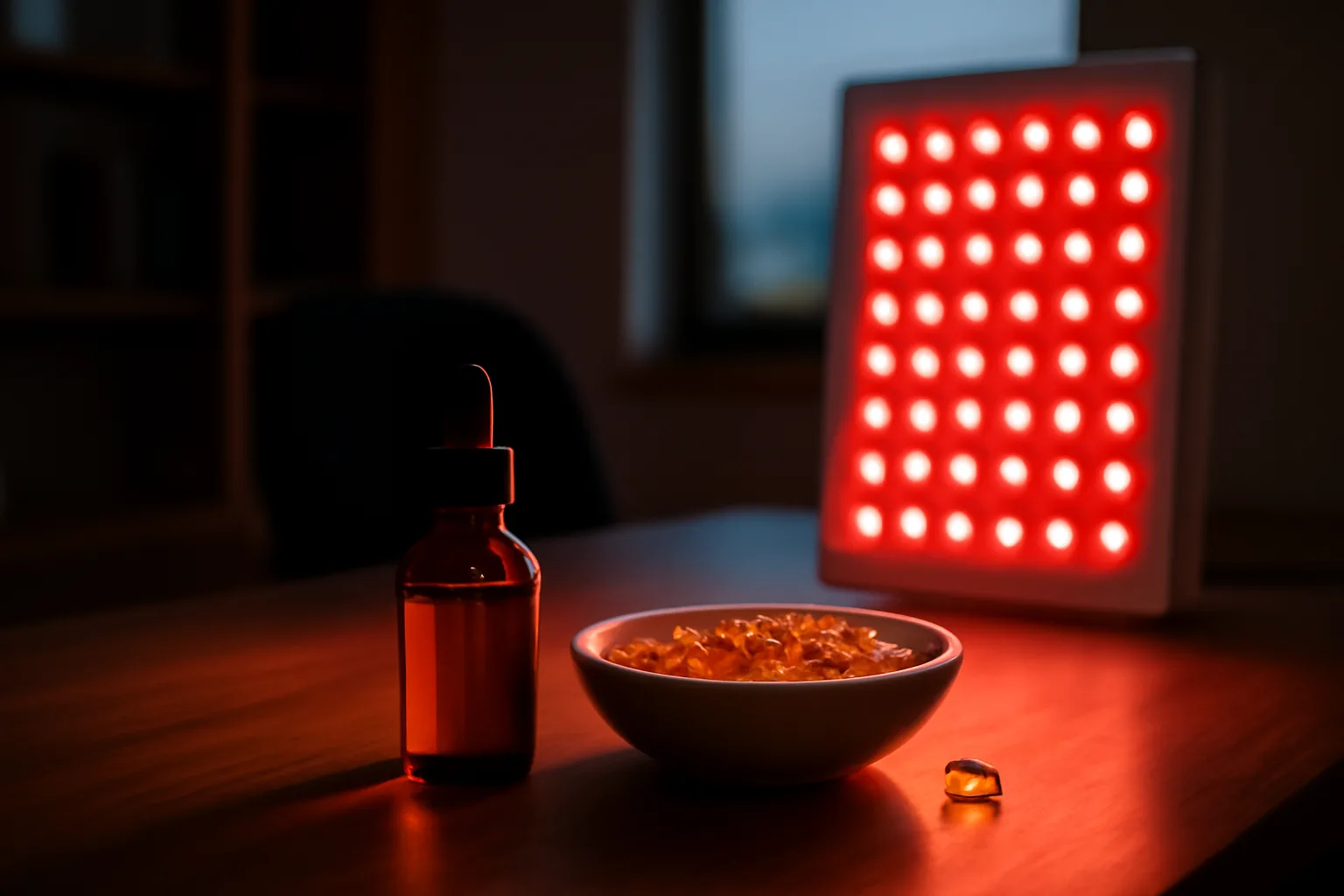
Red and near-infrared light therapy (photobiomodulation) is the closest thing to a genuinely non-pharmaceutical alternative with a real, growing human evidence base, though it's not a pill or supplement, it's a device-based approach. The proposed mechanism is that red/near-infrared light (roughly 600-1000 nm) is absorbed by cytochrome c oxidase in mitochondria, potentially increasing ATP production, similar conceptually to what methylene blue is claimed to do, but through light rather than a chemical redox shuttle. Small clinical trials have looked at photobiomodulation for wound healing, muscle recovery, and some neurological applications, with some FDA-cleared devices for specific indications like temporary muscle pain relief and some hair loss treatments. It has not been established as an energy or cognitive enhancer in healthy people through large trials. If you're mechanism-matching rather than looking for a supplement, red light devices are worth knowing about as the nearest analog. Cost and device quality vary enormously, and claims on product marketing pages often outrun the actual trial evidence, the same caution that applies to methylene blue itself.
Do methylene blue and antidepressants interact, and does that risk apply to natural alternatives?
This is the single most important safety fact in this whole comparison. Methylene blue is a monoamine oxidase inhibitor (MAOI). The FDA label carries a boxed warning stating that methylene blue can cause serious or fatal serotonin syndrome when combined with serotonergic psychiatric drugs, and it instructs providers not to administer methylene blue to patients taking serotonergic drugs, including SSRIs and SNRIs, except in specific life-threatening situations, and to stop those drugs and wait an appropriate washout period first [2]. This risk is specific to methylene blue's actual pharmacology. It is not shared by CoQ10, PQQ, NAD+ precursors, or red light therapy, none of these have meaningful MAOI activity or a documented serotonin syndrome interaction. That's a genuine safety advantage for the supplement alternatives if you're on an SSRI or SNRI and can't or won't stop it. If you're on any serotonergic medication (most common antidepressants, some migraine drugs, tramadol, and others), this alone is a reason to talk to a prescriber before considering methylene blue in any form, and it's a reason some people reasonably choose a supplement-based approach instead, even with weaker evidence, simply to avoid a dangerous drug interaction.
Is G6PD deficiency a reason to avoid methylene blue specifically?
Yes, and this is a second interaction that doesn't carry over to the 'natural' alternatives discussed here. Glucose-6-phosphate dehydrogenase (G6PD) deficiency is a common inherited enzyme condition, and the FDA label for methylene blue states it is contraindicated in patients with G6PD deficiency because it can trigger severe hemolytic anemia in this population [2]. G6PD deficiency affects an estimated 400 million people worldwide and is more common in people of African, Mediterranean, Middle Eastern, and Southeast Asian ancestry, according to the CDC's information on the condition in the context of malaria drug safety, where the same enzyme deficiency is relevant [5]. Many people don't know their G6PD status unless they've been tested, often after a reaction to another oxidant drug or certain foods like fava beans. CoQ10, PQQ, and NAD+ precursors don't carry this contraindication. If you have known G6PD deficiency, that's a hard stop on methylene blue and a reasonable, evidence-independent reason to look at alternatives instead.
Why does pharmaceutical-grade purity matter so much in this comparison?
This is where the 'natural alternatives' conversation gets genuinely dangerous if people cut corners. Methylene blue sold for aquarium use, textile dyeing, or lab/industrial purposes is not manufactured, tested, or labeled to pharmaceutical (USP) standards. It can contain heavy metals, solvents, and other contaminants that have no business going into a human body, and dosing on an aquarium product label has nothing to do with a safe human dose. This isn't a theoretical concern specific to methylene blue only, it applies broadly whenever people substitute an industrial-grade version of any compound for a pharmaceutical one to save money. The FDA-approved injectable methylene blue product (Provayblue) is manufactured under pharmaceutical GMP standards with defined purity, sterility, and dosing [2]. Non-pharmaceutical grade material has none of those guarantees. The same purity logic applies loosely to supplement alternatives too: CoQ10, PQQ, and NAD+ precursor supplements are regulated as dietary supplements in the US, which means far less premarket testing than a drug, and quality varies a lot between brands. Third-party testing (USP Verified, NSF, or similar) is worth checking for any supplement in this space, though it's a lower-stakes purity concern than the aquarium-grade methylene blue problem, which involves a product never intended for human consumption at all.
If someone still wants to try methylene blue, what does a safer path look like?
If you've weighed the off-label evidence, decided the mitochondrial or nootropic rationale is worth testing for yourself, and you don't have G6PD deficiency or a serotonergic medication conflict, the responsible path is a physician-supervised, pharmaceutical-grade (USP) product, not a bottle bought for fish tanks. A provider can screen for G6PD status if unknown, review your full medication list for MAOI and serotonin syndrome risk, and prescribe from a source that guarantees pharmaceutical-grade purity and accurate dosing. Methylene Blue Bio's provider-reviewed model is built around exactly that gap: connecting people to a licensed provider consult and a compounding pharmacy partner that fulfills pharmaceutical-grade methylene blue, rather than people sourcing unverified industrial product online. That's a materially different risk profile than buying from a supplement marketplace listing with no purity testing disclosed. For what actual before-and-after patterns and success rates look like in the people who do try it, see methylene blue before and after and methylene blue success rate.
How do the alternatives stack up side by side?
Here's a plain comparison of mechanism and evidence strength across the options discussed above. None of these are apples-to-apples substitutes, they work differently, so use this as a starting map, not a ranking.
| Option | Mechanism | Human evidence strength | Key safety notes | |
|---|---|---|---|---|
| Methylene blue (off-label use) | Direct mitochondrial electron shuttle, bypasses complex I/III | Small/early trials, mostly preclinical for energy/cognition claims [3] | MAOI, serotonin syndrome risk with SSRIs/SNRIs [2]; contraindicated in G6PD deficiency [2] | |
| CoQ10 | Natural electron carrier, complex I-III | Modest trial support for migraine, statin myopathy; weak for general energy [4] | Generally well tolerated, no MAOI risk | |
| PQQ | Proposed mitochondrial biogenesis stimulant | Very limited human trials | Generally well tolerated, limited long-term data | |
| NAD+ precursors (NR, NMN) | Raises NAD+ substrate levels | Reliably raises blood NAD+; functional outcome data inconsistent | Generally well tolerated in trials to date | |
| Red/near-infrared light therapy | Photon absorption by cytochrome c oxidase | Growing evidence for specific clinical uses (wound healing, some pain); limited for cognition/energy in healthy adults | Device quality varies; some FDA-cleared uses exist | The honest takeaway: if your priority is avoiding drug interactions and you have a serotonergic medication or unknown G6PD status, the supplement and light-based options are lower risk by mechanism, even though their evidence for the specific claims people want (energy, focus, longevity) is also thin. If you specifically want the redox-shuttle mechanism methylene blue offers, there isn't a real natural substitute for that particular chemistry. |
Frequently asked questions
Is there a natural substance that works like methylene blue?
No. Methylene blue is a synthetic phenothiazine dye, first made in 1876, with a specific redox-cycling mechanism in mitochondria [2][3]. No plant extract or naturally occurring compound reproduces that same chemistry, though CoQ10 and PQQ act on related mitochondrial pathways through different mechanisms.
Can CoQ10 replace methylene blue for energy?
Not really as a like-for-like swap. CoQ10 has modest trial support for migraine prevention and statin-related muscle pain, but NIH states there isn't enough evidence to support it for most other uses, including general energy [4]. It's lower risk than methylene blue but the evidence for an energy boost is weak in both cases.
Does methylene blue interact with antidepressants?
Yes, seriously. Methylene blue is an MAOI, and the FDA label carries a boxed warning about serious or fatal serotonin syndrome when it's combined with serotonergic drugs like SSRIs and SNRIs [5]. This is a real, documented risk, not a theoretical one, and it's a major reason some people look at natural alternatives instead.
Is methylene blue safe for someone with G6PD deficiency?
No. The FDA label lists G6PD deficiency as a contraindication because methylene blue can trigger severe hemolytic anemia in people with this enzyme condition [1]. G6PD deficiency affects an estimated 400 million people globally, more commonly in certain ancestries, per CDC data [6]. Testing before use is worth discussing with a provider.
What is methylene blue actually FDA-approved to treat?
Methemoglobinemia, a blood disorder where hemoglobin can't properly release oxygen to tissues, usually from drug exposure or a genetic enzyme issue [1]. Any use for energy, focus, mood, or anti-aging is off-label, meaning it's not what the FDA reviewed clinical trial data for.
Why is aquarium-grade methylene blue dangerous?
It isn't manufactured, tested, or labeled to pharmaceutical (USP) standards, and can contain contaminants like heavy metals or solvents that have no place in the human body. Aquarium product dosing has nothing to do with a safe human dose. Pharmaceutical-grade product from a licensed pharmacy is a different category entirely.
Do PQQ supplements have solid human trial data?
Not much yet. The mitochondrial biogenesis mechanism is interesting in cell and animal research, but human trials are few, small, and mostly look at surrogate markers rather than hard energy or cognition endpoints. Treat strong marketing claims around PQQ with real skepticism until better trials exist.
Does NMN or NAD+ supplementation actually boost energy?
Trials in older adults show NR and NMN reliably raise blood NAD+ levels, a real measurable effect. Whether that improves felt energy, muscle function, or cognition is still unsettled, results across studies have been inconsistent and effect sizes on functional outcomes have generally been small.
Is red light therapy a real alternative to methylene blue?
It's the closest mechanism match, since both are proposed to affect cytochrome c oxidase in mitochondria, one via light, one via a chemical redox shuttle. Red light has decent evidence for specific uses like wound healing and some pain conditions, but not established evidence for energy or cognition in healthy people.
Can I take methylene blue with my SSRI if I lower the dose?
No, dose reduction doesn't remove the risk. The FDA label instructs against giving methylene blue to patients on serotonergic drugs except in specific life-threatening situations, and calls for stopping the serotonergic drug and an appropriate washout period first [5]. Don't attempt this without direct medical supervision.
What's the safest way to try methylene blue if I want to test it?
Get screened for G6PD deficiency and review your medication list with a prescriber first, then use a pharmaceutical-grade (USP) product from a licensed pharmacy rather than industrial or aquarium-grade material. Methylene Blue Bio's provider-reviewed model connects people to that kind of licensed consult and compounding pharmacy fulfillment.
Are natural mitochondrial supplements regulated the same way as methylene blue as a drug?
No. CoQ10, PQQ, and NAD+ precursors are sold as dietary supplements in the US, with far less premarket testing than an FDA-approved drug. Methylene blue's approved injectable form is manufactured under pharmaceutical GMP standards with defined purity and dosing [1]. Quality control differs a lot between the two categories.
Sources
- FDA, Provayblue (methylene blue injection) prescribing information: FDA-approved indication for methemoglobinemia, G6PD deficiency contraindication, boxed warning on serotonin syndrome
- Science History Institute, History of methylene blue: Methylene blue's origin as a synthetic dye and its early use in medicine by Paul Ehrlich
- PubMed/NIH, mitochondrial electron transport mechanism of methylene blue: Methylene blue can act as an alternative electron carrier bypassing complex I and III in mitochondria in preclinical models
- NCCIH, Coenzyme Q10: Evidence strength and NIH statement on insufficient evidence for CoQ10 across most uses
- CDC, G6PD deficiency and antimalarial drug safety: G6PD deficiency prevalence and populations more commonly affected