 Plays from YouTube when you click
Dr. Michael Ruscio, DC, DNM · February 24, 2025 · 46:25 · 25,573 views
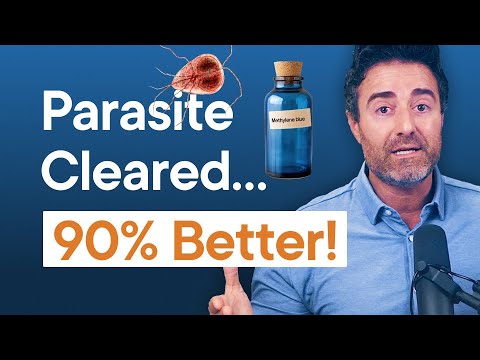
One patient's recovery, a die-off theory, and what was: the main claim
A patient with years of gut symptoms and brain fog recovered on a stack of herbs and methylene blue, which the host reads as treatment of hidden vector-borne infections, with flares read as microbe die-off.
Partly right, mostly unproven. In this interview a clinic host walks a patient named Greg through seven years of fatigue, brain fog and loose bowels that, by his account, lifted within a month of adding herbs and methylene blue. As evidence it counts for one uncontrolled case.
Three things limit it. Greg started several antimicrobials together (oregano, clove, cinnamon and a list of named herbs besides methylene blue), so nothing can be credited to any single one. He skipped testing, so no infection was ever confirmed in him, and the host concedes that testing matters for harder cases. His earlier regimens also worked for a while before fading, a pattern the host reads as chronic infection but which fits many other explanations.
The clinic's before-and-after scores are the best data in the video, and they are modest evidence. A symptom severity score fell from 39 to 28 and a quality-of-life score rose from 38 to 49 over about three months, on questionnaires Greg completed himself, with no comparison group. The host says the questionnaires are an imperfect tracking tool, and he is right.
The gap is the thing to take away. Nothing in the human record we hold tests methylene blue against babesia or Bartonella; the entries cover surgical dye, shock, antidote use and a few old psychiatric studies. The video sets that aside and treats flares as proof the treatment is landing.
One patient's recovery, a die-off theory, and what was: what holds up
- Insists on a G6PD blood test before anyone starts a high-dose course of methylene blue. A review reports that giving it to G6PD-deficient patients is prohibited because of hemolysis from oxidative stress and even death (PMID:37694789). It is the one safety screen the video names, and it is the correct one. Source
- Describes a second patient whose heart rate and blood pressure rose on treatment, who was followed by a local cardiologist while the team went slowly. Handling a cardiovascular reaction as a medical event to monitor is sound, whatever its cause.
- Marks where the evidence stops in places. The host calls the babesia and hyperbaric timing advice clinician observation with no formal research behind it, and he says Greg's skip-the-testing route is the better-case exception.
- Uses symptom questionnaires rather than asking how a patient feels. The side benefit shows in Greg's account: the scores let him drop a SIBO diagnosis his symptoms did not match.
One patient's recovery, a die-off theory, and what was: what it skips or gets wrong
- Reads every outcome as confirmation. The rule given is that no change means the wrong treatment, while improvement or a flare means the right one. A reaction to cinnamon, oregano, garlic and methylene blue is put down to microbe die-off rather than intolerance. Nothing in the video tests die-off as a mechanism, and no result could have counted against it.
- Attributes a second patient's raised heart rate and blood pressure to Bartonella and the autonomic nervous system. Methylene blue has circulatory effects of its own. A 2026 review of septic shock says it lowers vasopressor requirements (PMID:40492955), and in a single shock case vascular resistance rose from 240 to 1204 dyn s/cm5 within 1 h of a dose (PMID:26310944). A direct drug effect competes with die-off as the explanation, and the video does not raise it. Source
- Skips the serotonin interaction. In a systematic review of parathyroid surgery, all 25 patients with neurotoxicity were taking serotonergic medication (PMID:22961511), and in an in vitro assay on human MAO enzymes methylene blue was a potent MAO-A inhibitor (IC50 0.07 uM; PMID:28377303). Greg mentions a past depression diagnosis, and the video does not ask whether anyone in this clinic's program takes antidepressants. Anyone on a serotonin reuptake inhibitor or similar drug, or with G6PD deficiency, should avoid it without a prescriber who knows the interaction. Agitation, tremor or fever after starting means stop and get care. Source
- Argues that label amounts are the lowest a manufacturer can defend and that chronic infections need several times more. No trial in our file tests higher amounts against babesia or Bartonella, and hemolysis from methylene blue is dose related (PMID:12845393). How much of an oral amount reaches the blood is also poorly mapped: in seven volunteers, oral exposure was far below intravenous (AUC 9 vs 137 nmol/min/ml, PMID:10952480). Stronger is an untested bet on both safety and benefit. Source
- Cites prevalence figures (37% babesia and 32% Bartonella across 10,000 test samples, and about 50% positive among people with three or more chronic symptoms). These come from people who were tested, not from the general public, and the second paper's title refers to abnormal laboratory values, which is not the same as confirmed active infection. Neither figure shows that treatment helps.
- Says hyperbaric oxygen roughly doubled efficacy when paired with immunosuppressive drugs, citing an inflammatory bowel disease meta-analysis, then moves on to fatigue and mitochondria. Our file holds no hyperbaric trial, so the claim is unchecked here, and it concerns bowel disease patients, not people with tick-borne symptoms.
One patient's recovery, a die-off theory, and what was: strengths and weak spots
Strengths
- Gives a detailed seven-year illness history, including the regimens that worked for a while and then faded.
- Shows named before-and-after questionnaires and states their limits.
- Names G6PD screening as a precondition for methylene blue.
- Labels some of its own advice as clinician observation rather than research.
Weak spots
- One uncontrolled case with several changes made at once.
- No organism was confirmed in the featured patient.
- Leaves out the serotonin interaction entirely.
- Frames flares, improvement and no change alike as support for the theory.
- The description sends viewers to the host's own clinic.
One patient's recovery, a die-off theory, and what was: our recommendation
Skim. The first third, Greg's history, shows how a long unexplained illness plays out, and the questionnaire segment shows how this clinic tracks change. Skip the die-off and higher-amount arguments, and treat the hyperbaric segment as unverified. Before anything involving methylene blue, read the parathyroid surgery review (PMID:22961511) for the serotonergic interaction and the G6PD review (PMID:37694789), and ask a prescriber about both.